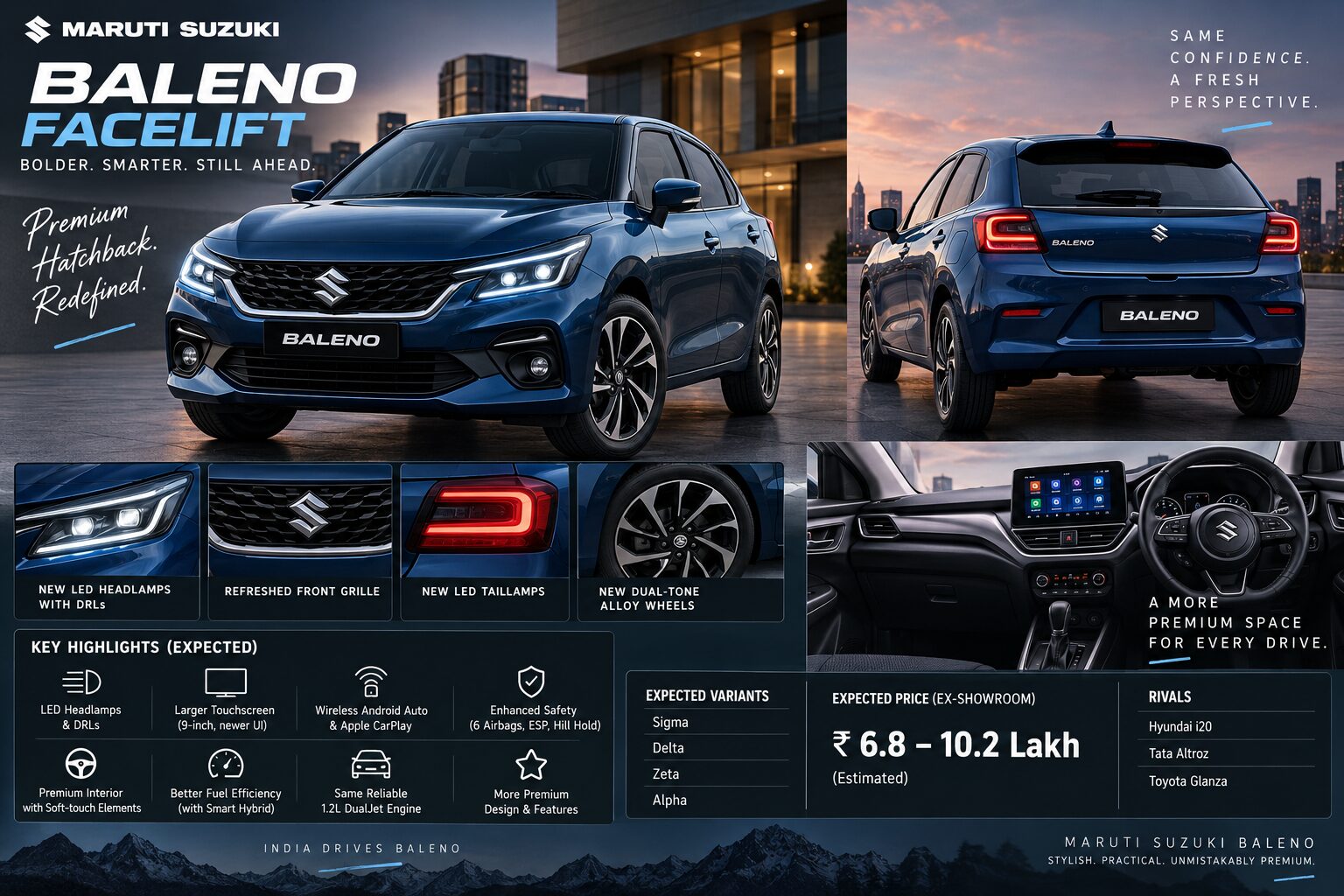
Baleno Facelift: Honest, Practical Changes to Know
The Baleno facelift is scheduled for September 5, 2026, bringing the first major update to the second-generation hatchback launched in 2022. Current reports point to styling revisions, extra equipment and changes aimed at keeping the premium hatchback competitive.
The timing matters because the Baleno competes against the Hyundai i20, Tata Altroz and Toyota Glanza. It also means buyers considering the outgoing car now have a good reason to wait before signing the paperwork.
But there is still a catch. Several details remain unconfirmed, and different automotive reports disagree about the engine, feature list and final pricing. So this article separates the reported information from what is still uncertain.
Baleno Facelift Launch Date
The Baleno facelift launch is scheduled for September 5, 2026, according to multiple automotive reports. Maruti Suzuki has been preparing the updated premium hatchback after the current generation spent several years with relatively limited changes.
As of September 5, however, the available reporting still includes pre-launch information rather than a complete official variant-wise price sheet. Business Today specifically reported that prices and several features remained unconfirmed shortly before launch.
That distinction is useful if you’re planning a purchase today. Don’t treat every leaked specification as final until Maruti Suzuki publishes the complete details.
For updates on the wider Maruti range, you can also check our [Maruti Suzuki cars](ADD YOUR URL) coverage.
Baleno Facelift Price: What to Expect
The expected Baleno facelift price is likely to sit slightly above the outgoing model because of the styling and equipment changes. Autocar India currently estimates a range of ₹6.97 lakh to ₹8.85 lakh, but labels these figures as expected rather than confirmed launch prices.
CarWale’s current estimate is broader, at roughly ₹6 lakh to ₹9.50 lakh ex-showroom. The difference between these estimates is a good reminder that the final price should not be treated as settled until Maruti announces it.
A sensible budget strategy is therefore:
- Use the current estimates only for preliminary planning.
- Wait for the official variant-wise price list.
- Compare the new price with discounts on outgoing stock.
- Get an on-road quotation before comparing financing offers.
If the facelift gets a noticeable premium without adding features you actually value, an outgoing Baleno with a strong discount could become the smarter purchase.
What Will Change on the Outside?
The Baleno facelift appears to be an evolutionary update rather than a completely new design.
Spy shots and reports indicate a revised front grille and bumper, while new alloy-wheel designs are also expected. The rear could receive a redesigned bumper, with fewer changes to the overall body shape.
The expected exterior changes include:
- Revised front grille
- Updated front bumper
- New alloy wheels
- Revised rear bumper
- Possible lighting revisions
Autocar India reports that the overall silhouette should remain familiar, with the update concentrated on the areas that are easiest to notice from outside.
That is good news if you already like the current Baleno’s proportions. It is less exciting if you’re expecting an entirely redesigned car.
Baleno Facelift Interior and Features
Inside, the Baleno facelift is expected to retain much of the current dashboard architecture instead of receiving a completely new cabin. Reports suggest that Maruti could improve the interior through upholstery, trim and feature additions.
Potential feature upgrades reported before launch include a larger infotainment screen, wireless phone charging and possibly ventilated front seats. Some reports have also mentioned ADAS, but these details should be treated as unconfirmed until the final equipment list is released.
The current Baleno already offers equipment such as automatic climate control, a head-up display, connected-car functions, an auto-dimming IRVM and a 360-degree camera on relevant versions, according to Autocar India.
This creates an interesting trade-off. If Maruti adds useful safety and comfort equipment without pushing the price too far upward, the facelift could be a meaningful upgrade. If most changes are cosmetic, the outgoing car may offer better value after discounts.
Baleno Facelift Engine and Gearbox
This is one area where reports currently conflict.
Autocar India expects the Baleno facelift to retain the existing 1.2-litre naturally aspirated petrol engine, with about 90hp and a five-speed manual or five-speed AMT. A CNG version is also expected to continue.
However, a CarWale report published on September 4 says the facelift is expected to use Maruti’s 1.2-litre three-cylinder Z12E petrol engine, producing 80bhp and 117Nm. It also reports the possibility of a CNG-AMT version.
Because these reports disagree, the engine should be considered [VERIFY: final engine specification at launch] rather than confirmed.
The same applies to the CNG automatic. CarWale reports it as a potential first for Maruti, while earlier reports expected the existing CNG-manual setup to continue.
Baleno Facelift vs Hyundai i20
The Hyundai i20 is one of the closest alternatives to the Baleno. Both target buyers who want a premium hatchback with a spacious cabin, modern equipment and manageable city dimensions.
The Baleno’s biggest traditional advantage has been its practical all-round character. The i20, meanwhile, gives buyers a more feature-focused alternative depending on variant.
| Factor | Baleno facelift | Hyundai i20 |
|---|---|---|
| Body style | Premium hatchback | Premium hatchback |
| Main appeal | Practical all-rounder | Feature-rich alternative |
| Facelift status | Major update expected | Existing model |
| Powertrain details | Final details to verify | Varies by variant |
| Best for | Buyers wanting a refreshed Baleno | Buyers comparing established alternatives |
Don’t choose between them solely on the brochure. A test drive can reveal differences in seating position, ride quality, visibility and gearbox behaviour that specifications won’t show.
For more context, our [hatchback buying guide](ADD YOUR URL) can help you compare cars beyond their headline features.
Who Should Wait for the New Baleno?
Waiting makes the most sense if you’re not in a hurry and the facelift’s expected equipment appeals to you.
The Baleno facelift is particularly worth waiting for if:
- You want the latest version rather than an outgoing model.
- New cabin technology matters to you.
- You want to compare the final price with discounted old stock.
- You plan to keep the car for several years.
- You are considering both petrol and CNG versions.
There is less reason to wait if a dealer offers a substantial discount on the current Baleno and you don’t care about the facelift’s cosmetic changes.
This is where timing becomes part of the buying decision. A new model isn’t automatically better value.
Baleno Facelift: What Is Still Unknown?
The biggest unanswered question is the final specification.
Reports disagree about whether the facelift will use the existing four-cylinder 1.2-litre petrol engine or the newer three-cylinder Z12E unit. Reported feature lists also differ, particularly around ADAS, the infotainment system and CNG-AMT availability.
The exact variant-wise prices also remain something you should [VERIFY: official launch price] before booking.
There is another practical unknown: how much dealers will charge on the road after registration, insurance and optional accessories. Even if the ex-showroom price looks attractive, your final invoice is what matters.
For that reason, don’t make a purchase decision based on a leaked specification sheet.
Is the Baleno Facelift Worth Waiting For?
The Baleno facelift looks more interesting as a value calculation than as a dramatic redesign.
If Maruti combines a modest price increase with genuinely useful equipment, the new version could remain a strong choice in the premium-hatchback segment. If the update is mostly visual and the price rises sharply, discounted outgoing cars could offer more value.
The closest alternatives deserve a proper test drive too. The Hyundai i20, Tata Altroz and Toyota Glanza remain relevant competitors, so Maruti can’t rely on the Baleno name alone.
The smart move is to compare three numbers: the facelift’s final on-road price, the discounted outgoing Baleno and the on-road price of your preferred rival.
Frequently Asked Questions
When will the Baleno facelift launch?
The Baleno facelift is scheduled for September 5, 2026. Multiple automotive reports have identified this date, although some detailed specifications were still unconfirmed immediately before launch.
What is the expected Baleno facelift price?
Current estimates vary. Autocar India lists an expected ₹6.97 lakh to ₹8.85 lakh range, while CarWale estimates roughly ₹6 lakh to ₹9.50 lakh, so the official price should be checked before booking.
Will the Baleno facelift get a new engine?
Reports disagree. Some expect the existing 1.2-litre petrol engine to continue, while CarWale reports a possible switch to the three-cylinder Z12E engine. This needs [VERIFY: official engine specification] at launch.
Will the Baleno facelift get CNG?
A CNG version is expected to remain available. However, whether the facelift introduces a CNG-AMT combination is still [VERIFY: final CNG transmission lineup].
Should you buy the current Baleno or wait?
If you’re not in a hurry, waiting lets you compare the facelift’s final price and equipment against discounts on the outgoing car. If the old model becomes significantly cheaper, it could be the better value.
Final Thoughts
The Baleno facelift is a refresh worth watching, but the final verdict depends heavily on pricing and the equipment Maruti actually puts into each variant.
The strongest reason to wait isn’t simply the new styling. It’s the chance to compare a fresh model against discounted outgoing stock and established rivals before spending your money.
If you’re buying soon, don’t rely on early reports for the engine, ADAS, CNG-AMT or final price. Check the official specification sheet and get an on-road quotation first. That’s the difference between buying the newest Baleno and buying the right Baleno.
For broader research, our [new car buying guide](ADD YOUR URL) can help you build a more complete shortlist.
Key Takeaways
- The Baleno facelift is an evolutionary update, so buyers shouldn’t expect an entirely new car.
- Waiting can improve your negotiating position because the facelift and outgoing model can be compared side by side.
- The biggest unresolved issue is the final engine and feature specification, with current reports disagreeing.
- A higher facelift price won’t automatically make it better value; discounted outgoing stock could be more sensible.
- The best decision will come from comparing final on-road prices, equipment and rival test drives rather than launch hype.
Also Read : Himalayan 440 On Road Price: Honest Cost Guide